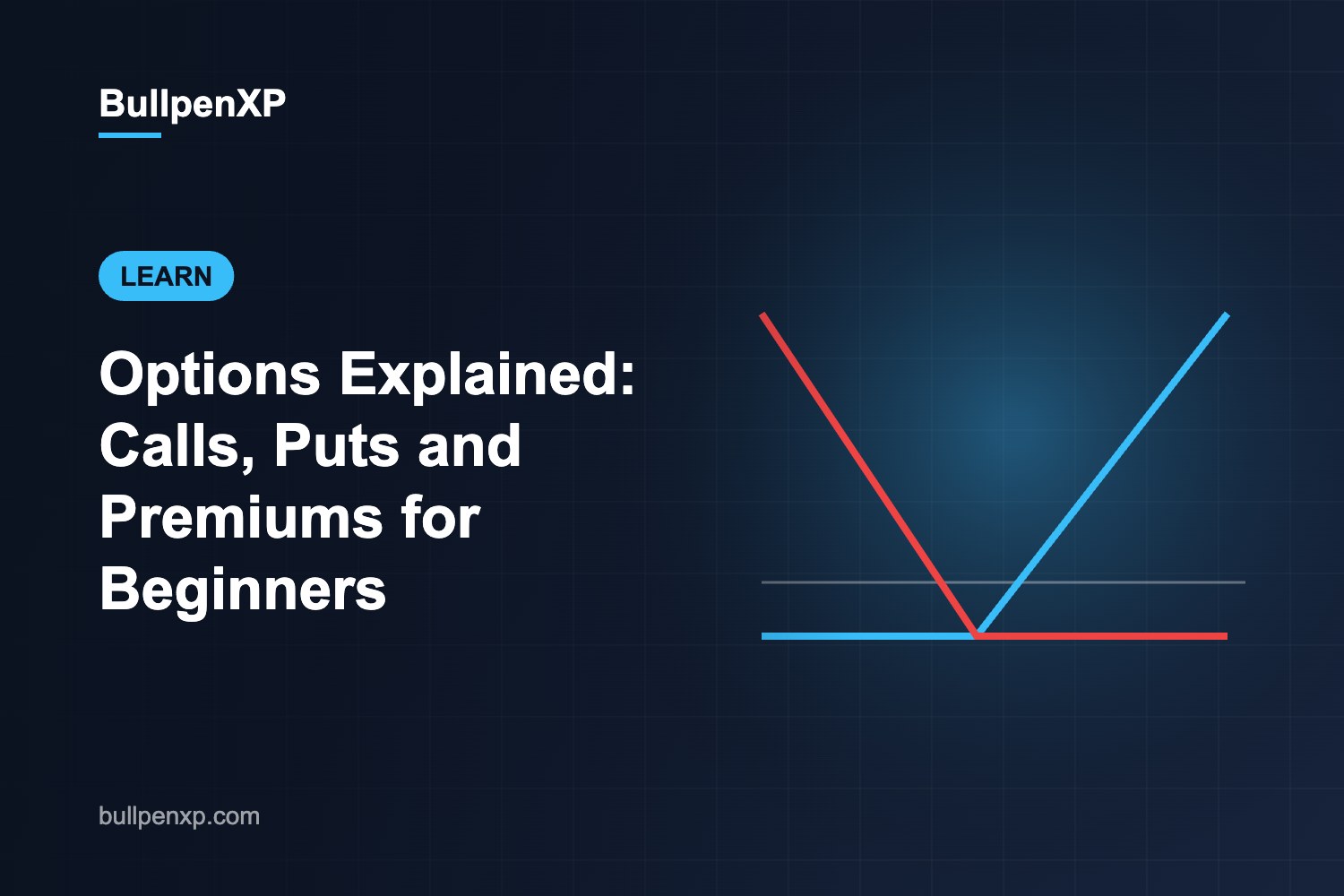
Options sound complicated, but the core idea is simple: you pay a fee for the right, not the obligation, to buy or sell something at a fixed price before a set date.
The short version
- A call gives you the right to buy at a set price. You profit if the price rises enough.
- A put gives you the right to sell at a set price. You profit if the price falls enough.
- When you buy an option, the most you can lose is the premium you paid.
- Options lose value as time passes (time decay), so being right about direction isn’t enough. You also need to be right about timing.
The building blocks
Every option has four key parts:
- Underlying: the asset it’s based on, like a share, an index or a currency.
- Strike price: the price at which you can buy (call) or sell (put).
- Expiry date: the last day the option is valid.
- Premium: the price you pay for the option.
On most exchanges, one stock option contract covers 100 shares. So a premium quoted at $2 costs $200 per contract.
A call option in practice
A share trades at $50. You buy a call with a $55 strike expiring in two months, paying $2 per share ($200 per contract).
- If the share rises to $62 at expiry, your option is worth $7 per share ($62 minus $55). Minus the $2 you paid, you make $5 per share, or $500 per contract.
- If the share ends at $56, the option is worth $1. You’ve lost $1 per share overall.
- If it ends at or below $55, the option expires worthless and you lose the full $200.
Your break-even is the strike plus the premium: $57 in this case.
A put option in practice
Same share at $50. You buy a put with a $45 strike for $1.50. If the share falls to $38, your put is worth $7, a profit of $5.50 per share. If it stays above $45, the put expires worthless.
Investors also use puts as insurance. If you own the shares, a put limits how much you can lose if the price drops, a bit like an insurance policy with a premium.
What moves an option’s price
- The underlying price: the closer it gets to (or the further it moves past) the strike, the more the option is worth.
- Time left: more time means more chances for the price to move, so longer options cost more. As expiry approaches, value drains away. Traders call this time decay (theta).
- Volatility: when markets expect big swings, options get more expensive. That’s why options often get pricier before earnings reports or central bank decisions.
Buying vs. selling options
Buying an option has a fixed maximum loss: the premium. Selling (writing) options is very different. The seller collects the premium but takes on the obligation. Selling a call without owning the shares can, in theory, lead to unlimited losses if the price shoots up. That’s why brokers restrict option selling for beginners and require extra approval and margin.
Risks to keep in mind
- Most short-dated options expire worthless. You can be right about the direction and still lose if the move comes too late or is too small.
- Leverage cuts both ways. A small premium controls a large position, so percentage gains and losses are huge.
- Liquidity: some options trade rarely, with wide gaps between buy and sell prices.
- Complexity: strategies with several options at once (spreads, straddles) are best left until you understand single options well.
How to get started safely
- Learn on a demo or paper trading account first.
- Start with buying options, where your risk is limited to the premium, rather than selling them.
- Use a regulated broker that offers exchange-listed options, and check whether options are available in your country. See our broker checklist.
- Keep each position small. Our risk management guide explains how.
Learn more
Options are complex and can lose value quickly. This guide is for education only and is not investment advice. Prepared with AI assistance.
Leave a Reply