VWAP shows the average price traders have paid during the day, weighted by volume. Big institutions use it as a benchmark, which is exactly why it matters to everyone else.
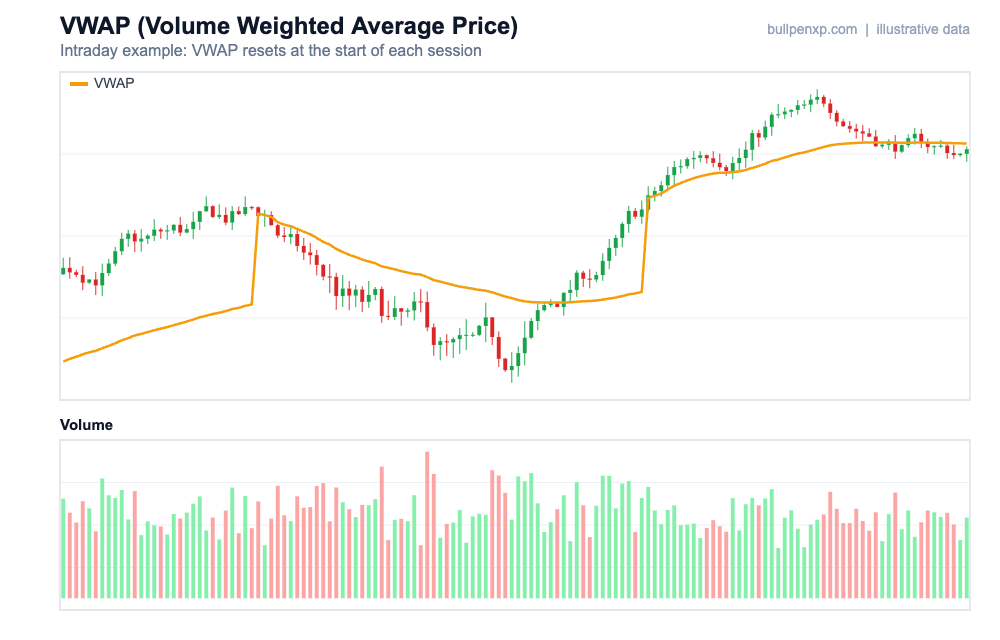
What it is
VWAP stands for Volume Weighted Average Price. It’s the average price of all trades during a session, where prices with more volume count more. It’s mainly an intraday tool: it starts fresh at the beginning of each trading day.
How it’s calculated
- For each bar, take the typical price: (high + low + close) divided by 3.
- Multiply it by that bar’s volume.
- Add up these values since the session started and divide by the total volume since the start.
Because it’s cumulative, VWAP moves a lot early in the session and becomes steadier as the day goes on.
Default settings
There’s no period to choose. VWAP resets every session. Many platforms also offer anchored VWAP, which starts from a point you choose, such as an earnings release or a major low.
How to read it
- Price above VWAP: buyers have been in control during the session; the average buyer is in profit.
- Price below VWAP: sellers have the upper hand.
- Price crossing VWAP repeatedly: a balanced, rangebound day.
Three practical ways to use it
- Intraday bias. Many day traders only look for long trades above VWAP and short trades below it. It’s a quick way to stay on the side of the day’s flow.
- Pullback entries. In a strong trending day, price often pulls back to VWAP before continuing. A bounce from VWAP with rising volume can be an entry.
- Execution benchmark. Institutions measure the quality of their trades against VWAP. If you buy below VWAP, you paid less than the day’s average price.
Common mistakes
- Using VWAP on daily or weekly charts without anchoring it. Standard VWAP is built for one session.
- Treating it as a guaranteed support level. On news days, price can slice through VWAP and keep going.
- Ignoring volume. VWAP is only meaningful in markets with reliable volume data. Spot forex, for example, has no central volume figure, so VWAP there is based on broker data only.
Works well with
- On-Balance Volume to check whether volume supports the move.
- Moving averages on higher timeframes for the bigger trend.
Quick summary
- VWAP is the volume-weighted average price of the session.
- Above VWAP favours buyers, below favours sellers.
- It’s an intraday tool and a benchmark used by institutions.
More indicator guides
This guide is for education only and is not investment advice. Charts use illustrative data. Prepared with AI assistance.
Leave a Reply